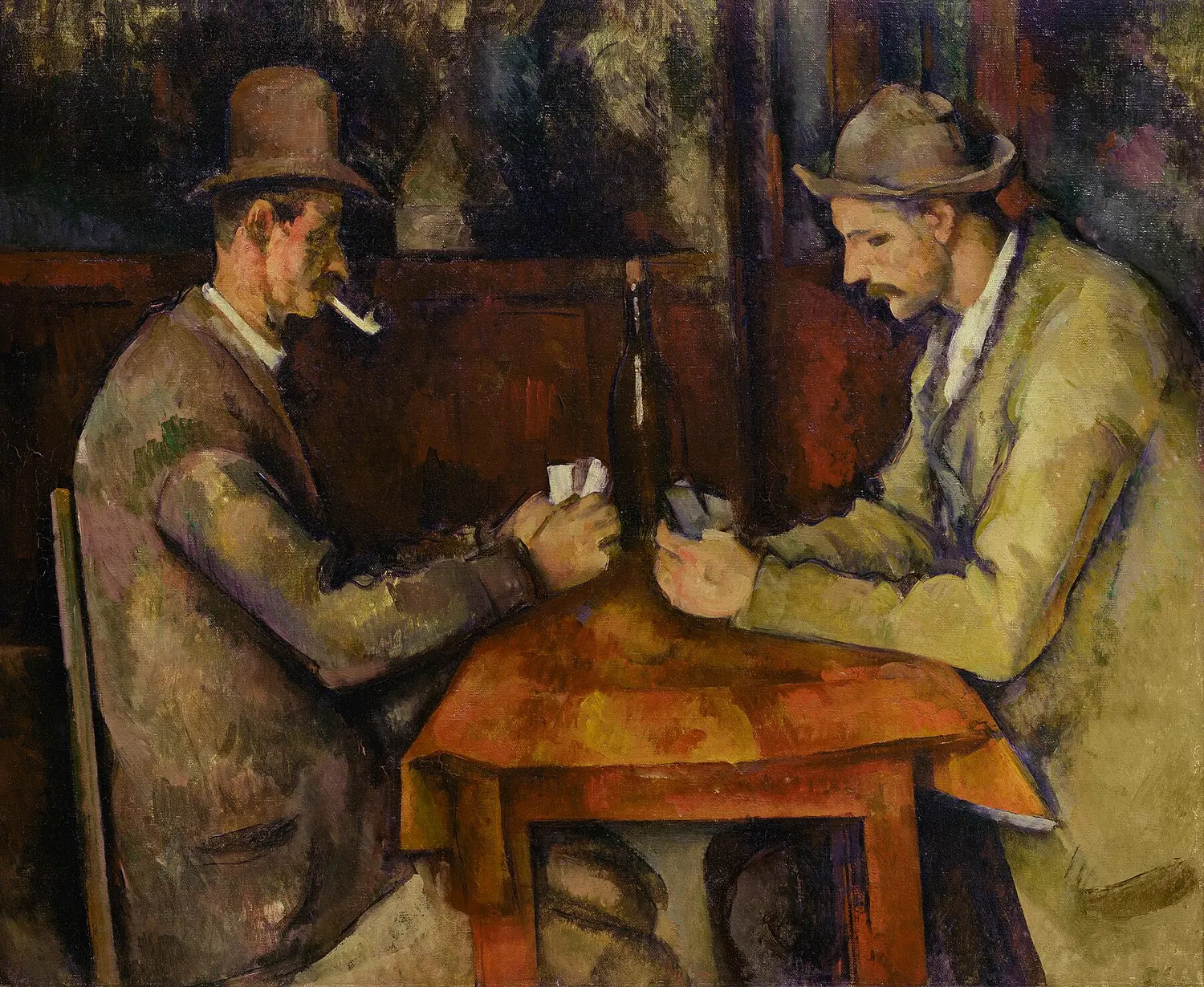
The Card Players
Two Provençal peasants play cards face to face across a table. Focused and still, they form a symmetrical composition, as solid as architecture. Cézanne painted several versions of this theme.
The father of modern art
Solitary and stubborn, Paul Cézanne sought to give painting the solidity of form, building apples, mountains and faces through colour. Picasso, Braque and Matisse regarded him as their master.
Born in Aix-en-Provence in 1839, the son of a banker, Paul Cézanne was a childhood friend of the writer Émile Zola. He gave up law for painting and left for Paris in 1861. Rejected by the Salon year after year, he exhibited with the Impressionists in 1874 and 1877 and learned much alongside Pissarro at Pontoise.
He then spent most of his life in Provence, working relentlessly, far from the art world. His first solo exhibition, organised by the dealer Ambroise Vollard in 1895, revealed his work to young painters. Caught in a storm while painting outdoors, he died in Aix in 1906.
Cézanne laid on colour in small parallel strokes that build up volumes. He simplified forms, combined several viewpoints in one picture and accepted distortions for the balance of the whole. In a letter he advised treating ’nature by means of the cylinder, the sphere and the cone’.
Two Provençal peasants play cards face to face across a table. Focused and still, they form a symmetrical composition, as solid as architecture. Cézanne painted several versions of this theme.
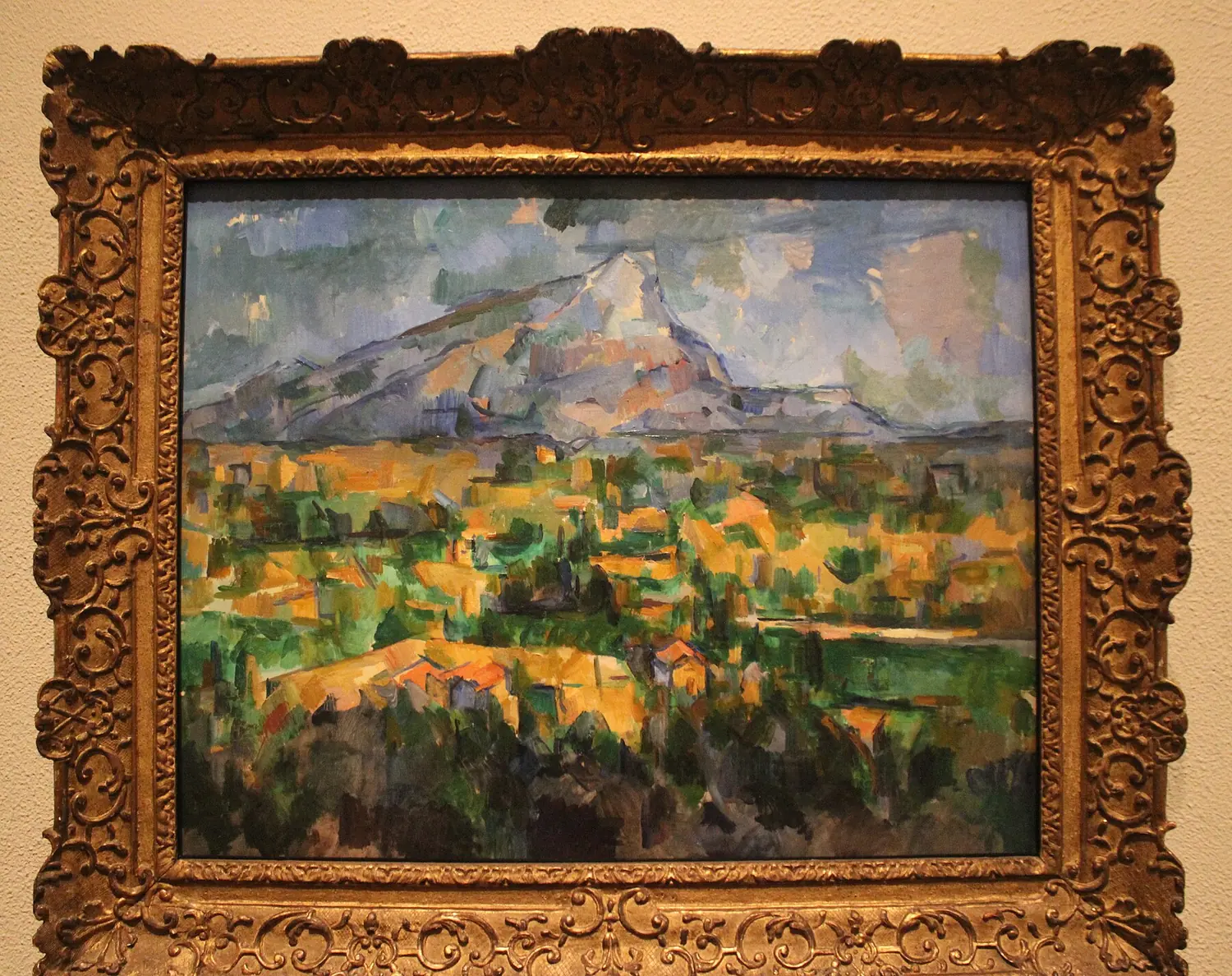
Mont Sainte-Victoire towers over the countryside around Aix, made of fields and houses reduced to patches of colour. Cézanne painted this mountain dozens of times, in oil and watercolour.
Photo: Miguel Hermoso Cuesta — CC BY-SA 4.0 — Wikimedia Commons
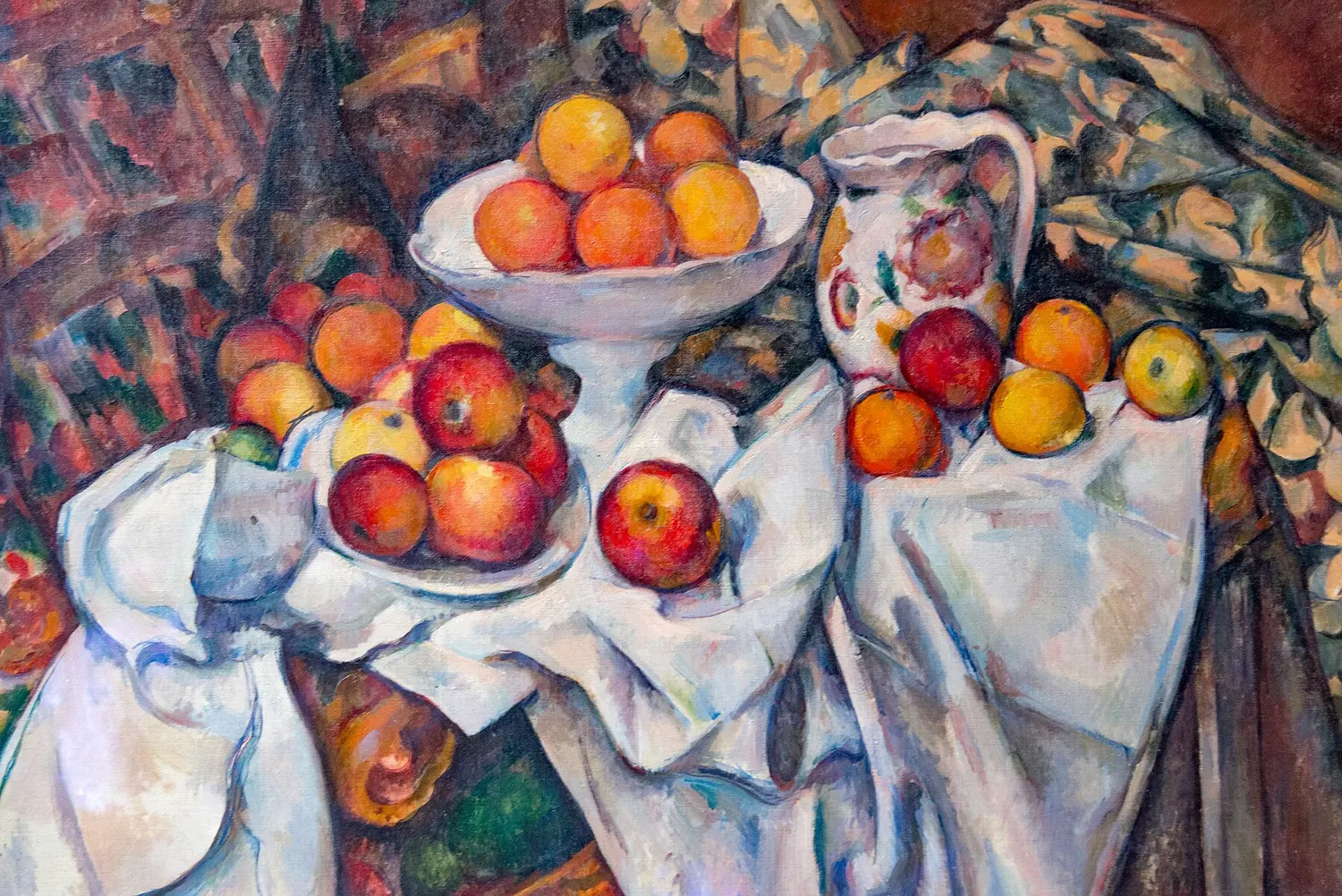
Apples and oranges are heaped on a crumpled white cloth, a fruit bowl and a plate, in front of a patterned fabric. The objects seem about to slide: Cézanne combined several viewpoints.
According to a witness, Cézanne once declared: ’I want to astonish Paris with an apple.’ His still lifes of fruit have become some of the most famous in the history of art.
 Alfred Sisley
 Claude Monet
 Berthe Morisot
 Pierre-Auguste Renoir
 Edgar Degas
 James McNeill Whistler
 Henri Rousseau
 Mary Cassatt