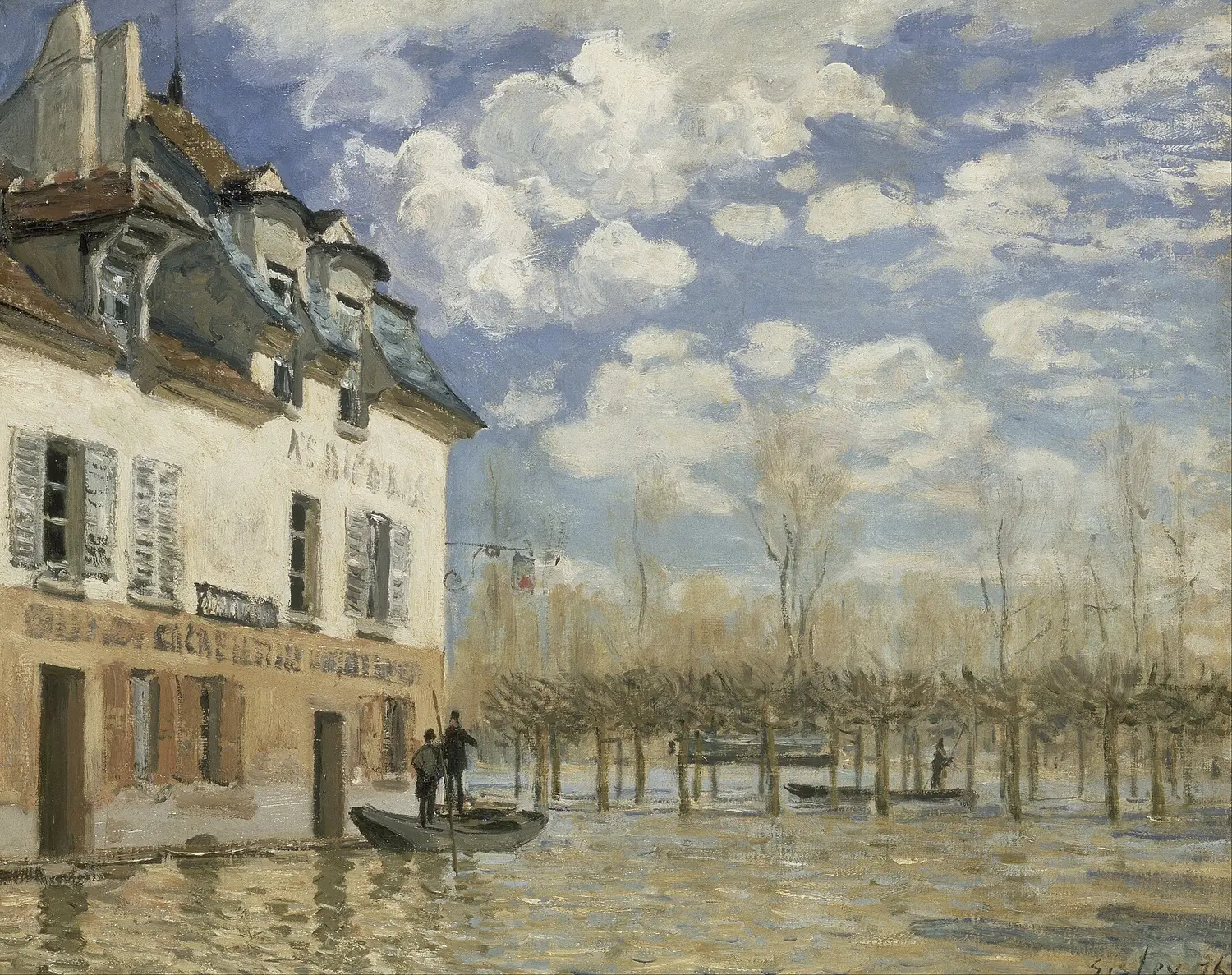
Flood at Port-Marly
The Seine overflowed at Port-Marly in 1876. The street has become a river with boats floating in front of an inn and a row of trees. Sisley painted several views of this flood.
The quietest of the Impressionists
Alfred Sisley devoted his whole life to landscape: changing skies, rivers, snow, villages around Paris. He remained poor and little known, but is now considered one of the Impressionists most faithful to open-air painting.
Born in Paris in 1839 to English parents, Alfred Sisley was sent to London to learn business, but returned to Paris to paint. In Charles Gleyre’s studio he became friends with Monet, Renoir and Bazille. The war of 1870 ruined his father’s business: from then on he had to live from his painting.
He lived in turn at Louveciennes, Marly-le-Roi, Sèvres and then near Moret-sur-Loing, whose church and riverbanks he painted. He exhibited with the Impressionists but sold with difficulty. British all his life, he applied late for French nationality and died in 1899 before obtaining it.
Sisley often gave the sky a large place, painting clouds and changing light with care. His touch is fine and regular, his compositions calm and balanced. He loved seasonal effects: snow, floods, frost, mist.
The Seine overflowed at Port-Marly in 1876. The street has become a river with boats floating in front of an inn and a row of trees. Sisley painted several views of this flood.
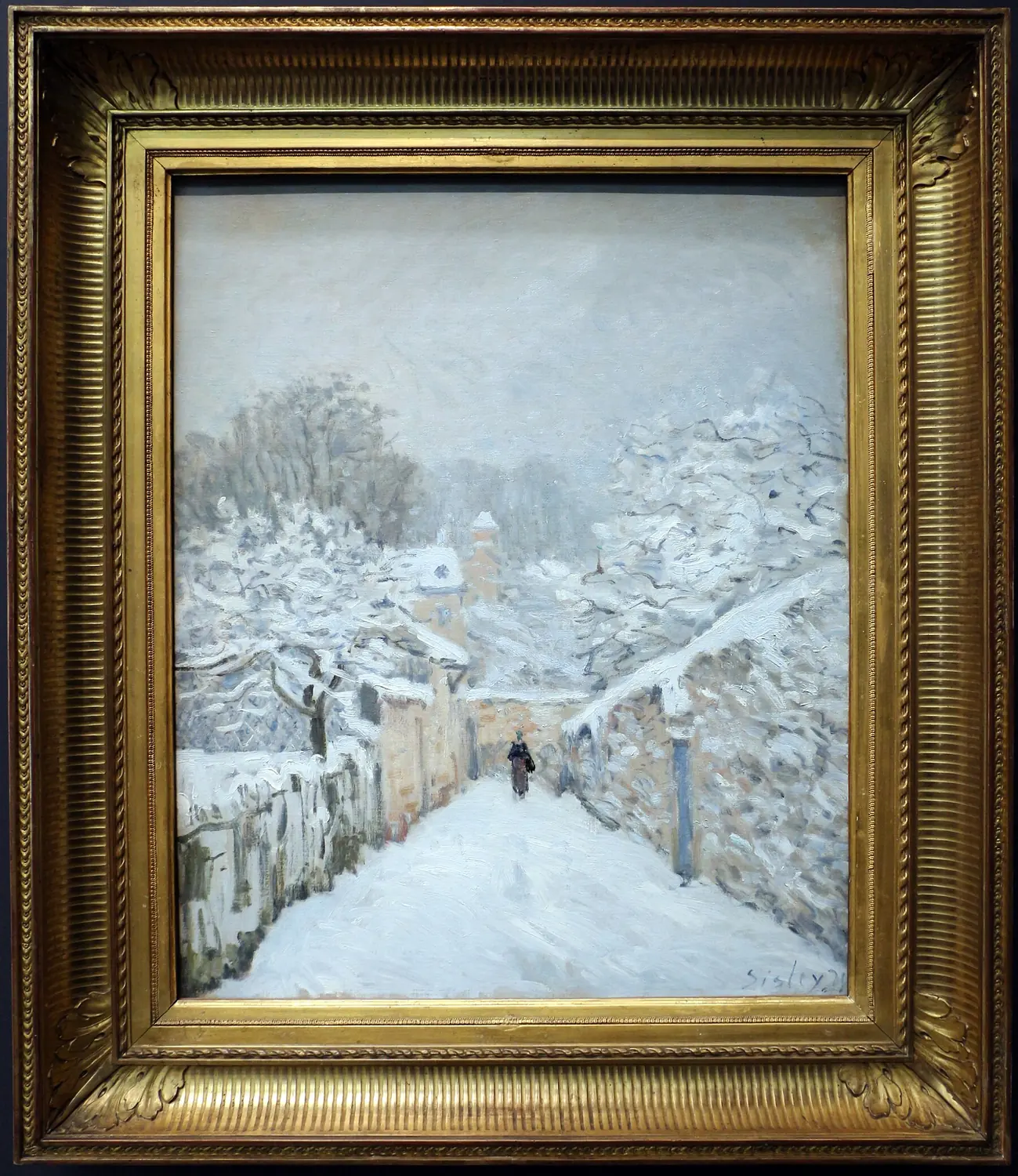
A village street under snow at Louveciennes. A figure walks beneath a soft grey sky; everything is silence and muffled light.
Photo: Sailko — CC BY 3.0 — Wikimedia Commons
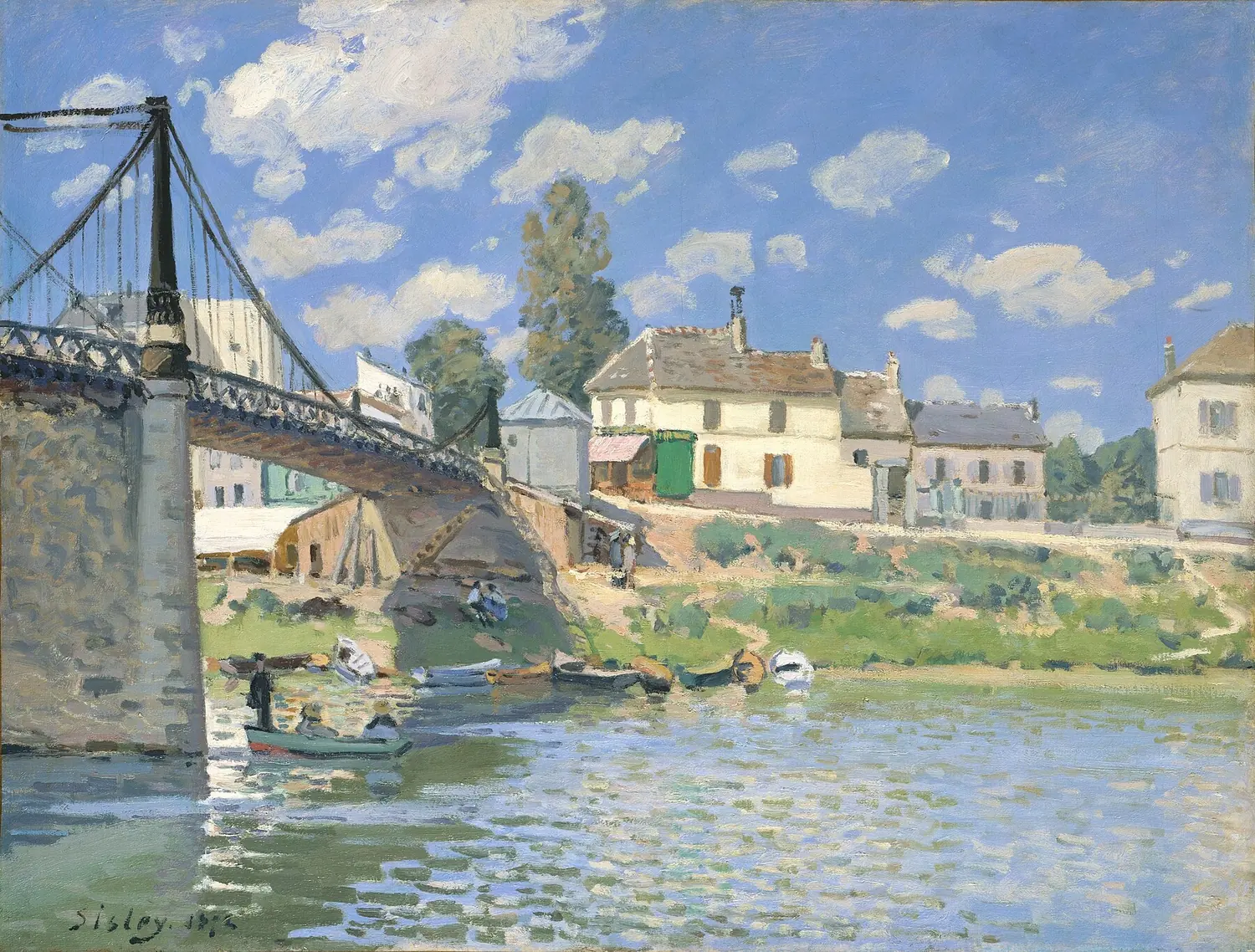
A suspension bridge spans the Seine at Villeneuve-la-Garenne. Walkers on the bank, boats and dancing reflections on the water make it a summer picture.
Shortly after his death his paintings began to sell for high prices, although he had struggled to feed his family all his life.
 Paul Cézanne
 Claude Monet
 Berthe Morisot
 Pierre-Auguste Renoir
 Edgar Degas
 James McNeill Whistler
 Henri Rousseau
 Mary Cassatt