I and the Village
A green-faced man and a cow look at each other; inside the cow’s head a little milkmaid milks another cow. Around them, the village, an upside-down peasant woman and blazing colours.
The poet of flying lovers
The works of Marc Chagall are still protected by copyright. We do not reproduce them: they are described below, with where to see them.
Born in a Jewish village in the Russian Empire, Marc Chagall painted all his life the memories of his childhood in Vitebsk: fiddlers on roofs, cows, lovers floating in the sky. He also created stained glass and the ceiling of the Paris Opéra.
Born in 1887 in Liozna, near Vitebsk, in today’s Belarus, Marc Chagall grew up in a modest Jewish family. He studied painting in St Petersburg and settled in Paris in 1911, at La Ruche, an artists’ colony. Back in Vitebsk in 1914, he married Bella, who would be his muse, and after the revolution founded an art school.
Returning to France in 1923, he became French in 1937, went into exile in the United States during the Second World War and then settled in the South of France. He made stained glass for cathedrals and synagogues, theatre sets and, in 1964, the new ceiling of the Opéra Garnier. He died in Saint-Paul-de-Vence in 1985, aged ninety-seven.
Chagall mixed memories, folk tales, Jewish traditions and dreams in weightless compositions where figures float and colours are free. He borrowed cut-up forms from Cubism and bright colours from Fauvism, but remained above all a storyteller.
The works of Marc Chagall are still protected by copyright. We do not reproduce them: they are described below, with where to see them.
A green-faced man and a cow look at each other; inside the cow’s head a little milkmaid milks another cow. Around them, the village, an upside-down peasant woman and blazing colours.
A giant green-faced fiddler plays standing on the roofs of a snowy village. Chagall returned to this motif all his life.
An immense ceiling of bright colours pays tribute to fourteen composers and their works, with dancers, angels and Paris monuments.
The fiddler perched on a roof, which Chagall painted many times, recalls the musicians who livened up celebrations in his native village.
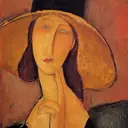 Amedeo Modigliani
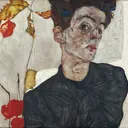 Egon Schiele
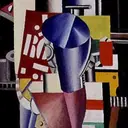 Fernand Léger