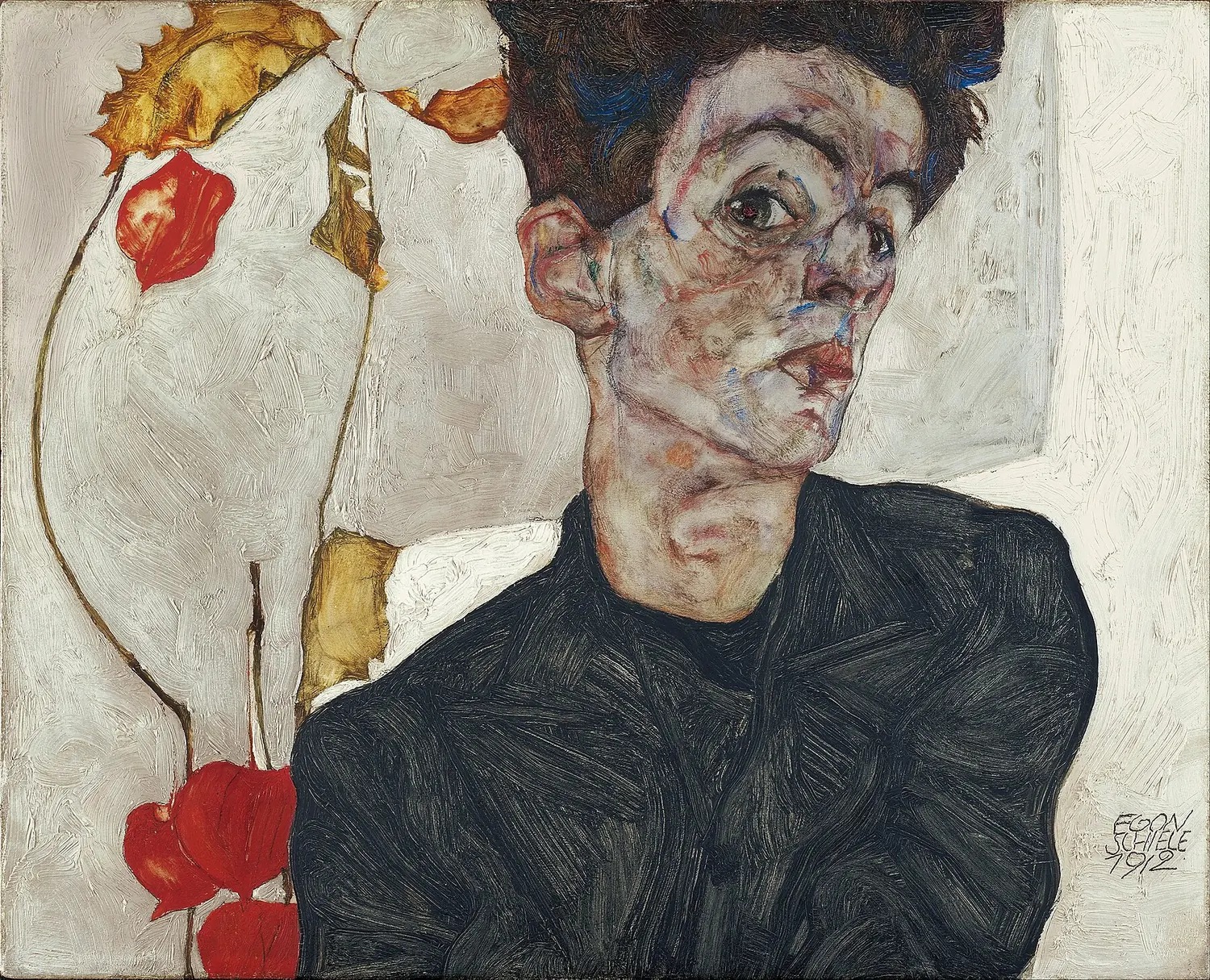
Self-Portrait with Physalis
The young painter shows himself half-length, head tilted, glancing sideways, beside a branch of physalis with small red lanterns. The empty white background heightens the tension of the figure.
Dead at twenty-eight, Egon Schiele left a body of work of rare intensity: tormented self-portraits, angular bodies, bare landscapes. His nervous drawing made him one of the great figures of Austrian Expressionism.
Born in 1890 in Tulln on the Danube, the son of a stationmaster, Egon Schiele entered the Vienna Academy of Fine Arts at sixteen and left it three years later, finding the teaching too rigid. Gustav Klimt, who admired his talent, encouraged him and introduced him to collectors and models.
His starkly frank nude drawings shocked Viennese society; in 1912 he was imprisoned for a few weeks and one of his drawings was burned in court. Called up during the First World War, he went on painting. In 1918, just as success was finally coming, he died of Spanish flu, three days after his wife Edith.
Schiele drew with an angular, taut, almost brittle line that stretches bodies and hands. His colours are often muted and earthy, heightened with touches of red or orange. His landscapes and towns, seen head-on, have a silent melancholy.
The young painter shows himself half-length, head tilted, glancing sideways, beside a branch of physalis with small red lanterns. The empty white background heightens the tension of the figure.
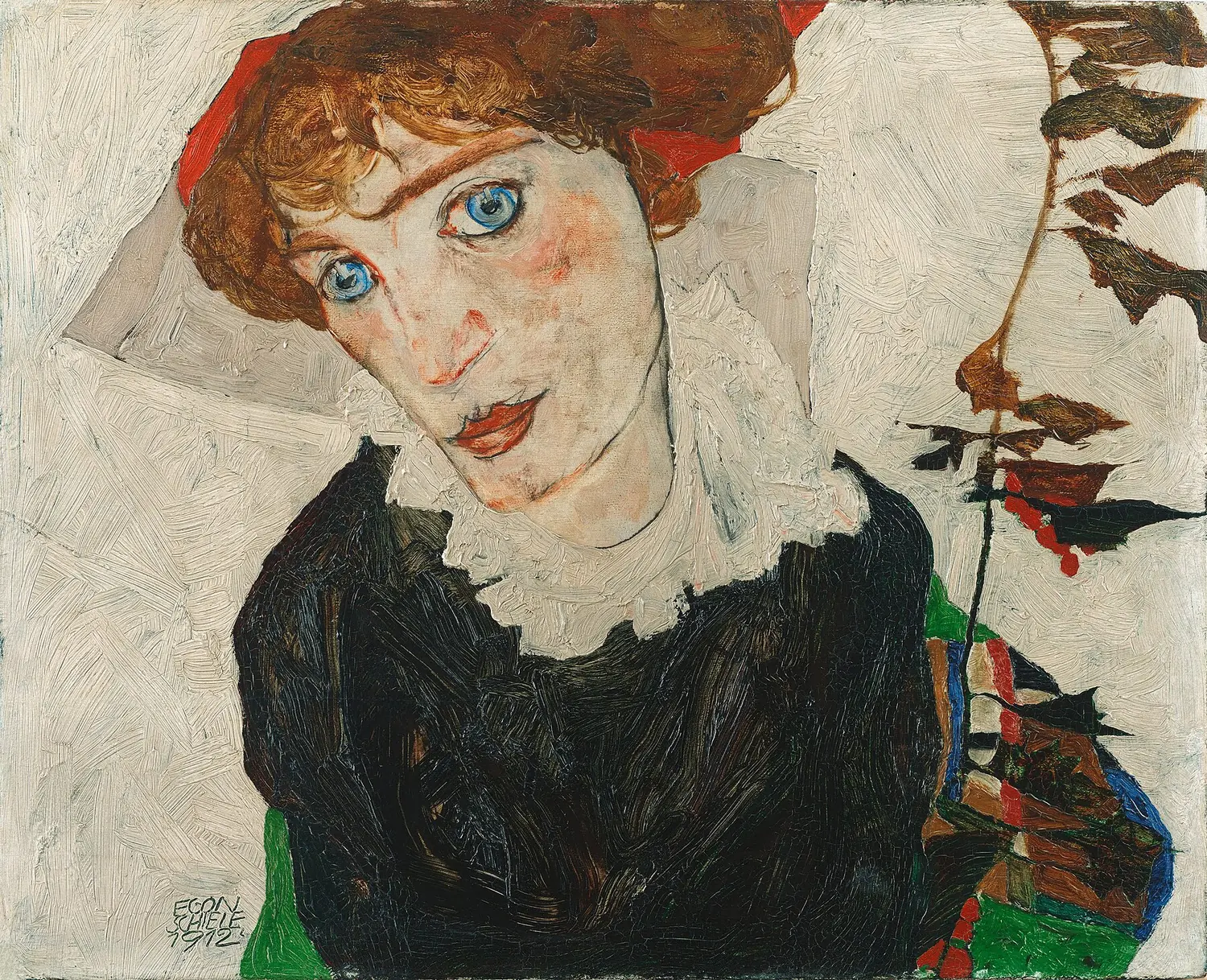
Walburga Neuzil, known as Wally, Schiele’s companion and model, looks at the viewer with large blue eyes, her head resting on her hand. This small portrait was the subject of a long restitution case after the Second World War.
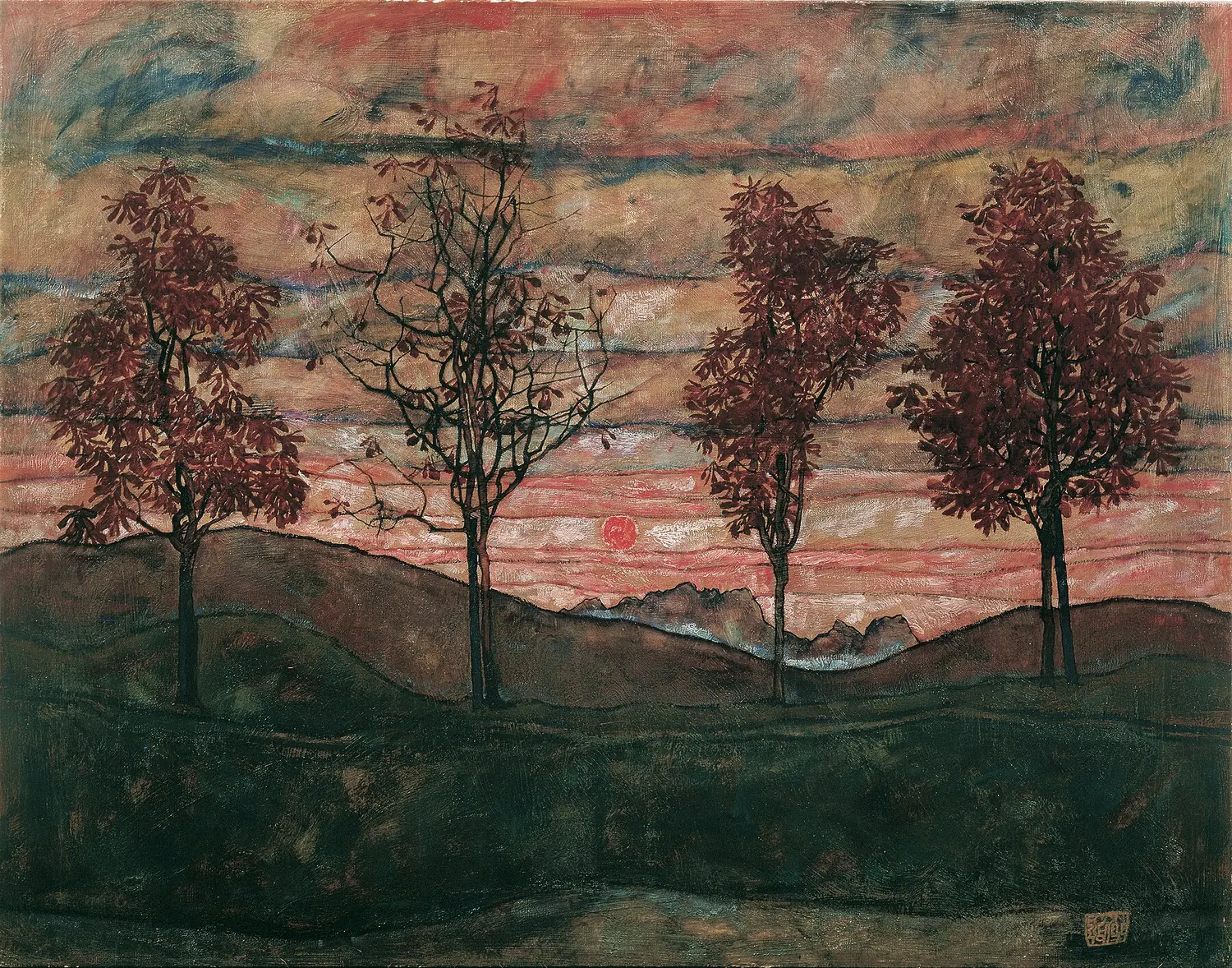
Four autumn trees stand in a row against a sunset, before a background of hills and bands of cloud. One of them has lost almost all its leaves. This calm landscape is built like a musical score.
Schiele made more than a hundred self-portraits, painted or drawn: grimacing, anxious, sometimes provocative, they explore every side of himself.
 Amedeo Modigliani
 Fernand Léger