lesPeintres.eu

Fernand Léger

Born: Argentan, 1881Died: Gif-sur-Yvette, 1955

The painter of the machine age

CubismFrance
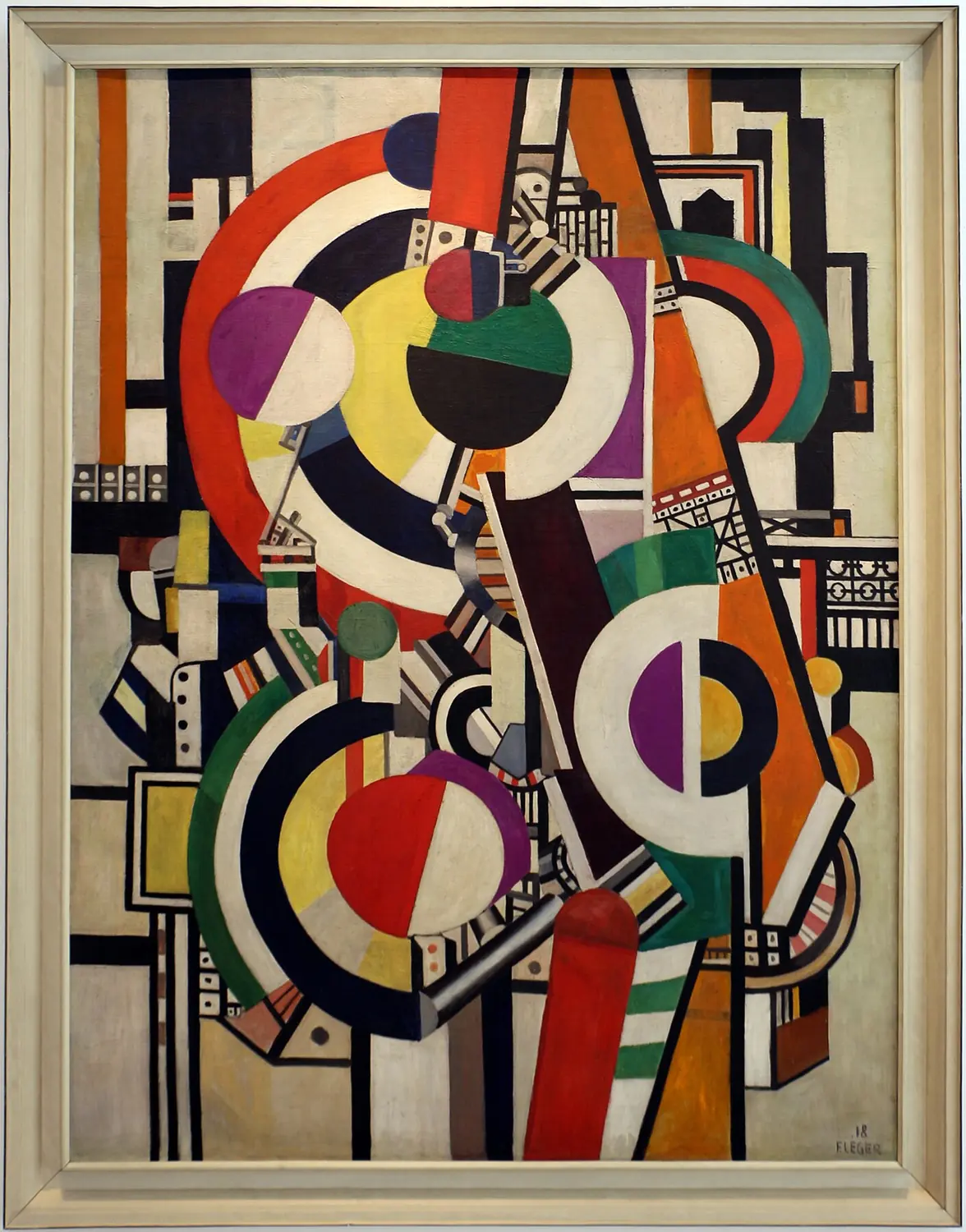
The Disks — Fernand Léger
The Disks, 1918 · Musée d’Art Moderne de Paris
Public domain — Wikimedia Commons

1In brief

Fernand Léger brought the modern world into painting: machines, cities, posters, workers. His tubular forms, pure colours and black outlines celebrate the beauty of industrial objects and the dignity of labour.

2Life

Born in 1881 in Argentan, Normandy, the son of a cattle breeder, Fernand Léger was first apprenticed to an architect in Caen and then worked as a draughtsman in Paris. He mixed with the Cubists and developed cylindrical forms, which earned him the mocking nickname ’Tubist’. During the First World War, as a sapper and then a stretcher-bearer, he discovered at the front the beauty of machines and the comradeship of soldiers.

After the war he painted the city and the machine, made the film Ballet Mécanique in 1924 and taught in his own academy. A refugee in the United States from 1940 to 1945, he discovered the neon lights of Broadway. On his return he painted workers, cyclists and acrobats, created mosaics and stained glass, and died in 1955 at Gif-sur-Yvette.
3Style and technique

Léger built his pictures from clean geometric shapes, cylinders, discs, cones, surrounded by black outlines, and pure colours laid flat. He rejected the Impressionist touch and sought a clear, strong, accessible painting, which he compared to posters and machines.

4Works

The Typographer — Fernand Léger

The Typographer

1919Philadelphia Museum of Art

A typesetter, reduced to geometric forms, leans over his work: a large blue cylinder for the head, red and pink planes for the body. In front of him a red sheet bears stencilled letters, like a poster. Léger pays tribute to the people who set newspapers and posters.

Public domain — Wikimedia Commons

The Disks — Fernand Léger

The Disks

1918Musée d’Art Moderne de Paris

Discs of colour, red, yellow, blue, black and white, interlock and turn like the cogs of a machine. The round forms contrast with straight bands in a joyful rhythm.

Public domain — Wikimedia Commons

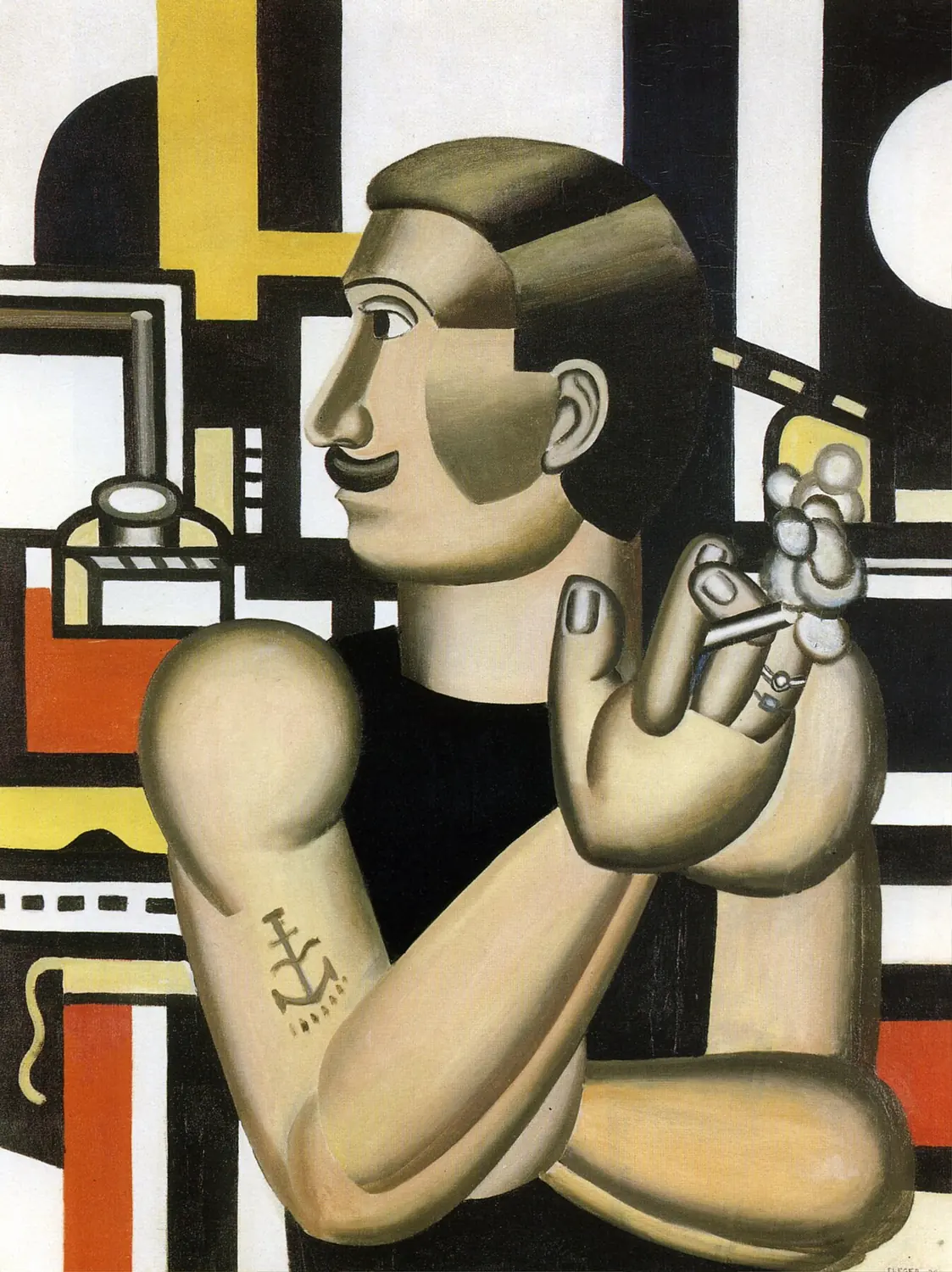
The Mechanic — Fernand Léger

The Mechanic

1920National Gallery of Canada, Ottawa

A mechanic, powerful and calm, poses in profile against a background of geometric shapes. With his moustache, cigarette and muscular arms, he embodies the dignity of modern work.

Public domain — Wikimedia Commons

5Did you know?

Léger said that at the front in 1916, the breech of a 75mm gun lit by the sun had dazzled him more than all the paintings in the museums: the gleam of metal taught him to paint the machine.

6Further

Contemporaries