Nighthawks
At night, through the large window of a lit corner diner, we see three customers and a waiter. The street is empty; there is no visible door to get in.
The painter of urban solitude
The works of Edward Hopper are still protected by copyright. We do not reproduce them: they are described below, with where to see them.
Edward Hopper painted ordinary 20th-century America: diners at night, hotel rooms, gas stations, façades in the sun. His silent figures, bathed in harsh light, seem to be waiting for something that never comes.
Born in 1882 in Nyack, New York, Edward Hopper studied painting in New York and then went to Paris three times between 1906 and 1910. For nearly twenty years he earned his living as an advertising illustrator, a job he hated, and sold very few paintings.
In 1924 he married the painter Josephine Nivison, who posed for almost all his female figures and kept the record book of his works. Success came that same year with an exhibition of watercolours. He lived and worked in a studio on Washington Square in New York, and in summer on Cape Cod. He died in New York in 1967.
Hopper built simple, geometric compositions with large flat areas of colour, sharp shadows and very frank light, natural or electric. Windowpanes, windows and open doors make the viewer a discreet witness. His paintings have greatly inspired cinema.
The works of Edward Hopper are still protected by copyright. We do not reproduce them: they are described below, with where to see them.
At night, through the large window of a lit corner diner, we see three customers and a waiter. The street is empty; there is no visible door to get in.
A young woman in coat and hat, alone at a table, looks into her cup of coffee. Behind her the black window reflects two rows of lights.
At dusk, a small lit gas station beside a country road, at the edge of a dark forest. A man tends the pumps.
The film-maker Alfred Hitchcock drew on a Hopper painting, House by the Railroad, to imagine the house in the film Psycho.
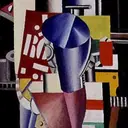 Fernand Léger
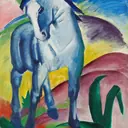 Franz Marc
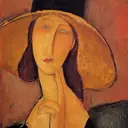 Amedeo Modigliani
 Paul Klee