Houses at L’Estaque
Houses reduced to ochre cubes and green trees pile up on a hill, without sky or horizon. This painting inspired the word ’Cubism’.
Co-inventor of Cubism with Picasso
The works of Georges Braque are still protected by copyright. We do not reproduce them: they are described below, with where to see them.
The son of a decorative painter, Georges Braque invented Cubism with Picasso, and then papier collé. A painter of still lifes and musical instruments, he pursued all his life a calm, poetic exploration of space.
Born in 1882 in Argenteuil, Georges Braque grew up in Le Havre and learned his father’s trade of decorative painter: imitation wood and marble, stencilled lettering. He first painted in the Fauve manner, then discovered Cézanne. In 1907 he met Picasso: for seven years the two artists worked side by side, ’like two mountaineers roped together’, Braque said.
In 1908 a critic spoke of his ’little cubes’, hence the word Cubism. In 1912 he glued imitation woodgrain paper into a drawing: the first papier collé. Seriously wounded in the head in 1915, he returned to painting after a long convalescence. He painted still lifes, studios and birds, decorated a ceiling in the Louvre in 1953 and died in Paris in 1963.
Braque broke objects into facets, reduced colour to browns, greys and ochres, and introduced letters, fake wood, sand or sawdust into his pictures. Violins, guitars, mandolins and sheet music constantly reappear in his still lifes, for their curved shapes and their link with rhythm.
The works of Georges Braque are still protected by copyright. We do not reproduce them: they are described below, with where to see them.
Houses reduced to ochre cubes and green trees pile up on a hill, without sky or horizon. This painting inspired the word ’Cubism’.
A violin and a pitcher break into grey and brown facets. At the top, a trompe-l’œil nail with its shadow reminds us that the picture is also an object.
On the ceiling of the Henri II room, two large black birds with white outlines fly against a deep blue ground. One of the Louvre’s rare modern decorations.
In 1961 Braque became the first painter to be exhibited at the Louvre during his lifetime.
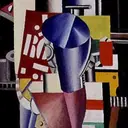 Fernand Léger
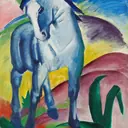 Franz Marc
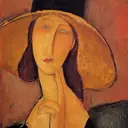 Amedeo Modigliani
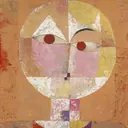 Paul Klee