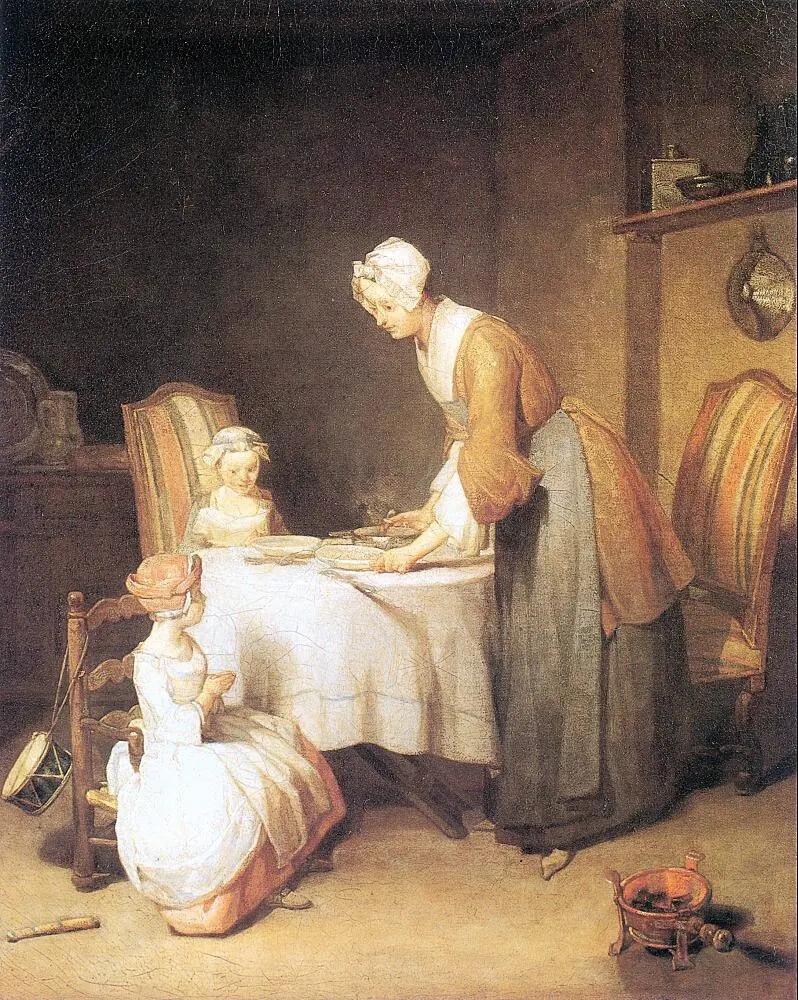
Saying Grace
A mother serves the meal and waits for her youngest daughter to say grace before eating. The elder girl smiles slyly. The softness of light and gesture makes this ordinary moment unforgettable.
The poetry of simple things
Painter of everyday objects and domestic scenes, Jean Siméon Chardin gave humble things a new presence and dignity. Diderot saw in his pictures ’nature itself’.
Born in 1699 in Paris, the son of a carpenter who made billiard tables, Chardin spent his whole life in Paris. In 1728 he was received into the Royal Academy thanks to The Ray, a striking still life, on the very day he presented his work.
He then painted genre scenes, the peaceful life of Parisian families, much admired and spread through engravings. Late in life, as his eyesight weakened from oil pigments, he took up pastel and made self-portraits wearing spectacles. He died in 1779 at the Louvre, where he had lodgings.
Chardin painted slowly, in grainy layers and small juxtaposed touches that make light shimmer on a goblet, a peach or a face. His compositions are simple and balanced, his colours soft, his figures absorbed in a task.
A mother serves the meal and waits for her youngest daughter to say grace before eating. The elder girl smiles slyly. The softness of light and gesture makes this ordinary moment unforgettable.
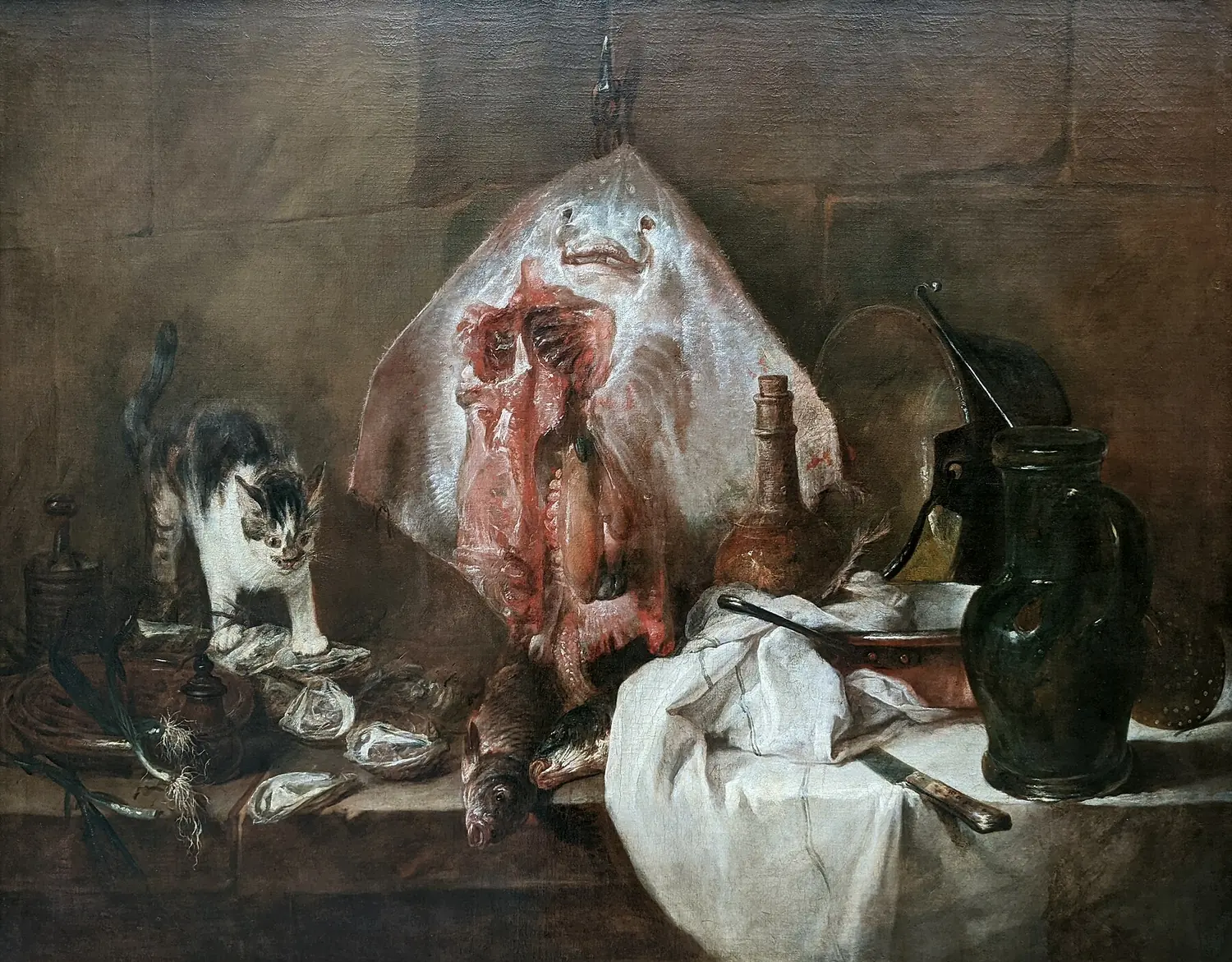
A gutted ray hanging from a hook seems to have a face. Beside it, a bristling cat walks over oysters. This astonishing picture opened the doors of the Academy to Chardin.
CC0 — Wikimedia Commons
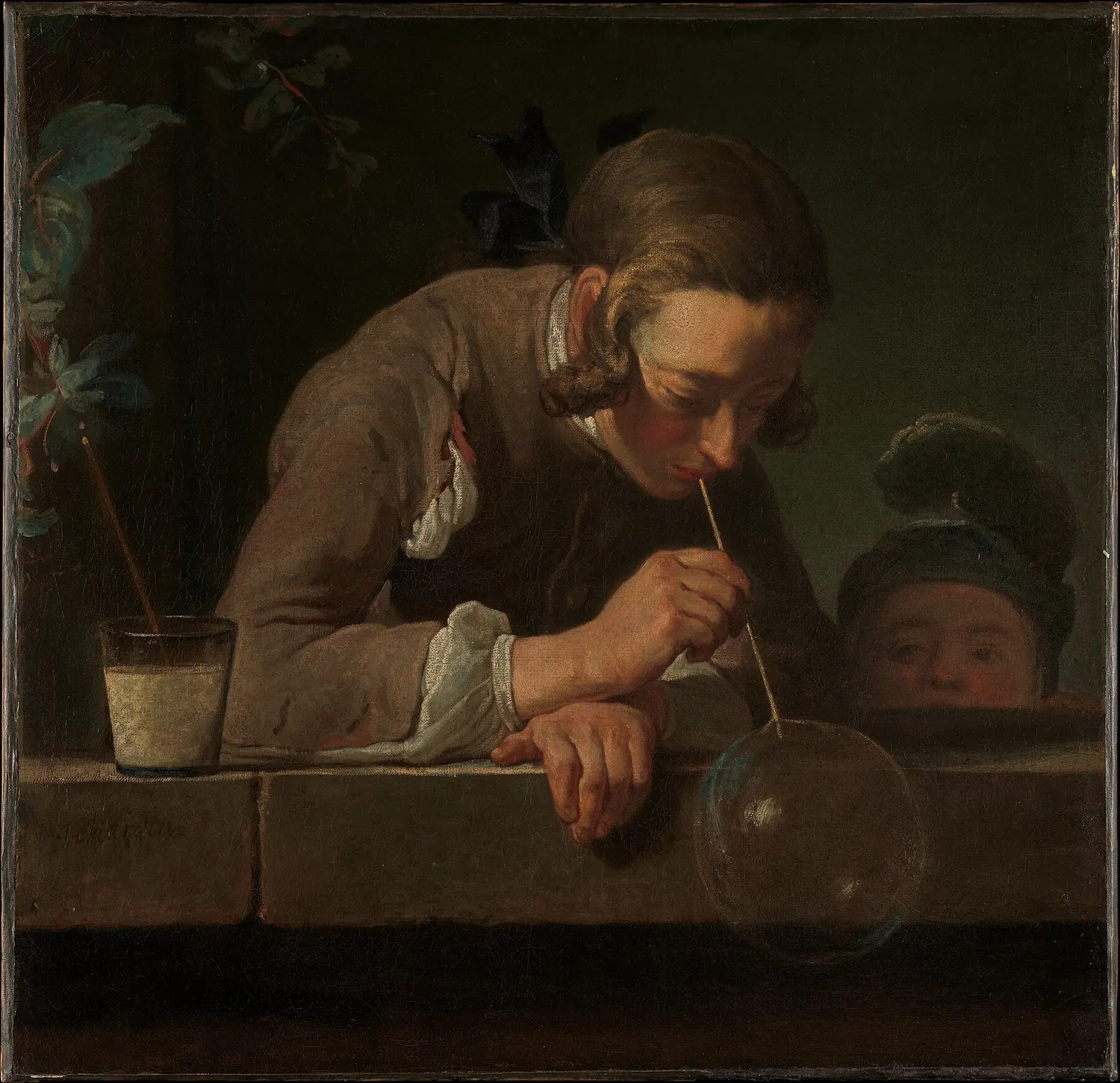
A young man leaning out of a window blows a big soap bubble through a straw while a child watches. The fragile, shiny bubble reminds us that everything is fleeting.
The Metropolitan Museum of Art — CC0 — Wikimedia Commons
Saying Grace pleased King Louis XV so much when it was presented to him in 1740 that Chardin had to paint several replicas.
 Canaletto
 François Boucher
 Antoine Watteau
 Thomas Gainsborough
 Jean-Honoré Fragonard
 Francisco Goya
 Jacques-Louis David
 Élisabeth Vigée Le Brun