Perspective
How to show depth on a flat surface: a vanishing point, a horizon line and a little geometry.
A Renaissance invention
Around 1415 the Florentine architect Filippo Brunelleschi demonstrated a geometric method for representing space. The scholar Leon Battista Alberti described it in 1435 in his treatise On Painting. Masaccio’s Holy Trinity is one of the first paintings built this way.
Horizon and vanishing point
The horizon line is at the viewer’s eye level. All parallel lines moving away from us, like the edges of a road or the lines of a tiled floor, seem to meet at a single point on the horizon: the vanishing point. The further away an object is, the smaller it looks.
Atmospheric perspective
The air between us and distant objects makes them paler, blurrier and bluer. Leonardo da Vinci observed and theorised this, calling it ’aerial perspective’, and used it in his landscapes.
Playing with the rules
Once the rule is mastered, painters break free of it: Caillebotte exaggerates receding lines to create speed, Cézanne combines several viewpoints, the Cubists shatter space, and Japanese prints offer other ways of building depth.
The further, the smaller
Look at a long road or train tracks: the further away they go, the closer together they seem, until they touch in the distance!
The magic point
Renaissance painters discovered a secret: all the lines going into the distance meet at a single point. It is called the vanishing point.
Blue air
Far away, mountains look blue and blurry. Painters do the same to show they are very far away.
Challenge
Draw a straight road going towards the horizon, with trees on each side: they must get smaller and smaller.
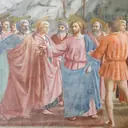 Masaccio
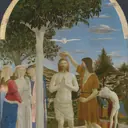 Piero della Francesca
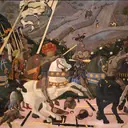 Paolo Uccello
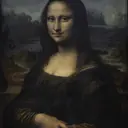 Leonardo da Vinci
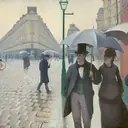 Gustave Caillebotte
 Paul Cézanne